Every piece of information in the wold has been copied. Backed up. Except the human mind, the last analog device in a Digital World.
— Robert Ford.
I remember the deep churning sounds that my first computer used to make as I pressed the power button on the CPU. I remember a high-pitched whirring, followed by rumbles from the inside of this large white box tucked neatly under the desk in my mother’s room. I remember the familiar sound of the Windows XP start theme. I even remember how funny the cursor and the hourglass next to it looked to me as the desktop was loading. What I don’t remember at all is how life ever was in the absence of all this.
When I turned 7, my parents told me they had prepared a surprise for me. My mother led me by the hand into her room and pointed to her desk; a strange gray object with a shiny black surface lay silently on top of it. With my father’s help, I got on the chair. I saw my face and my long hair distorted strangely on the lustering darkness. And suddenly – colors! My reflection got swallowed in a lush sea of swirling pixels, blue, red, green, and black.
I’ve been swallowed by the digital world in this way for as long as I can remember; to some extent, we all have. The first moment where I turned on my first computer coincides with my very first conscious memories. I can’t see my life without some form of digitized medium because I’ve never had a life without one – not one that I remember, at least. To my generation, that’s exactly the nature of the digital. It’s not just a part of how we interact with each other, or of how we define ourselves socially in the online environment; for me and my generational peers, it played a formative role. It’s been there all along, tracing our development, coloring our early years, embedding the digital world within us.
As I write this down on my computer, I keep trying to recollect details about learning how to use one. I can’t. To remember life without something is to have a life before it; I don’t have a life that I know of before computers. Even to my creative mind, thinking about the first time I used a keyboard or a mouse or even YouTube is like thinking about when I first learned how to walk – I’ve known how to walk since before I can recall knowing how to walk. But this is a peculiar thing; not all people share this mindset.
It was years after i got my first computer, in 2016. Netflix had just arrived to Lebanon, so I set up an account for my family. My parents were both skeptical. Even so, my mother eventually made a ritual out of watching some TV show, usually a soap, on Sundays after lunch. From 2016 to the present day, she still asks me to her room every Sunday if I’m home. Why? She can’t even remember how to log on to Netflix and find her TV shows.
To my mother, computers have always been a mystery. When her old Dell laptop stops working properly, I’m the one who fixes it. ‘Mom’, I’ve said to her, ‘let me teach you how to fix things yourself.’ I’ve tried many times, but it somehow never sticks. She can remember how it was when computers weren’t around; to my mother, the computer, the keyboard, the mousepad, the touchscreen, they’re all tools that one learns, methods to be practiced and developed. I often wonder at this – how must it be to even be capable of conceiving of a world without technology? My mother can do this, so can my father; so can their entire generation and so can all those before. They have memories of a me-before-the-digital that I don’t have myself.
For people like my parents, thinking about the digital world is thinking about the external world; for me, it means thinking about the internal world, about myself. Over a decade ago, I was swallowed by my computer screen, just like I was when I was a little girl. And I’m still in there. We must understand our relationship to the digital world, my generation especially – after all, it’s about who we are.
Who doesn’t love mystery books? The mystery books of murder specifically have always been a puzzle that satisfy the reader’s mind. That’s where Stevenson’s stories pop up. His novels are partly horror fiction as well as a mysterious puzzle to solve. He caught our attention since we had already read some of his works and we liked his writing style full of grit, drama and excitement. What we love about it is that we enjoy linking the hints and the unexpected parts of the story to solve the crime, but at the same time, we feel the terror behind the murder’s danger. We also found a pattern that was recurring in his novels: he loved to showcase the duality between good and evil, and how each and every one of us is haunted by both of them. His best example of that to date is surely in The Strange Case of Dr. Jekyll and Mr. Hyde where the main characters, Jekyll and Hyde are both the same person, and each one of them respectively represents good and evil. However, in that story it is highlighted to the extreme since one of them is a highly respected and likeable doctor, and the other has a horrific personality and is a murderer. In addition, we realized that all of his stories have male characters as the protagonist and that some of them even completely lack female characters throughout the whole story; which reflected the Victorian Era he used to live in. And so, our final DH project is entitled: “Robert Louis Stevenson: The duality of good vs evil expressed through male characters”.
Picture of a couple during the Victorian Era
The main goals of our project were to be able to dig as much information on Robert Louis Stevenson’s life achievements as possible and to link them with the two main topics mentioned above:
The duality of Human Nature: Good vs Evil
The underwhelming role of women in the Victorian Era
Snapshot of Distant Reading vs Close Reading slide
Using numerous digital tools and platforms such as Voyant-Tools, CliC, Google My Maps and TimelineJS helped us explore and study our project from different perspectives. Our final DH project was presented in a timeline which helped us keep track of our research and all the information we gathered concerning our topic in a very precise and neat way.
Since we started working on our project, we really dug deep into Robert Louis Stevenson’s work and made sure that the goals we set for our final outcome could be met by analyzing his novels. We focused on what stood out the most in Stevenson’s stories and we noticed that he was obsessed with the contrast of good and evil as he compared it to the society surrounding him; we felt like this fitted what we wanted to do exactly in order to portray the Victorian Era mentality. So we didn’t really feel like we had to change the direction of our project since it projected Stevenson’s vision about human nature. Also we noticed a notable lack of counting on female characters in his works, and felt like this was a point needed to be developed, since the role of women has greatly progressed since the Victorian Era, and this merely gave us an idea of how our world is changing.
Snapshot of the Victorian Era slide
Born and educated in Edinburgh, Stevenson suffered from serious bronchial trouble for much of his life, but nevertheless continued to write and travel widely in defiance of his poor health. While mapping the author’s life achievements, we realized that he was so dedicated to his writing considering he was able to write one of his most famous novels The Strange Case of Dr. Jekyll and Mr. Hyde in just over a month. In addition, he got inspired by his many travels and chose the places he visited for the settings of his stories. Another reason behind his travels was the people he met along the journey; he met the love of his life as well as a lot of influential people that helped him in his writing career to become the Robert Louis Stevenson we know in our modern time. Stevenson was fascinated by the human’s duality and shows it when Dr. Jekyll confesses to Utterson that his own duality captivated him, a condition that affects all men.
A picture of the life of Robert Louis Stevenson
Voyant-Tools and CliC helped us understand his novels without actually reading them by highlighting the most repeated words, that were pretty much male-related, looking for the sentences located before or after a certain word, finding hidden aspects in plots by transforming them into networks… In addition, it allowed us to have an unbiased opinion on these books since these platforms examine the texts as is without having any emotions involved as we would if we had read them. For example, if we, the female members of the group, had to read the corpus and study it, we would have probably been offended by the lack of female characters and our analysis would have been different because of our emotions towards the stories. Moreover, Distant Reading compiles objective data about many, many works. While computers can’t ‘read’ and understand a novel in the way people can, they are very good at searching for specific information you give them and finding patterns. And this allowed us to gain a lot of knowledge about his works in a very direct way.
Snapshot of CliC slideSnapshot of Voyant Tools slide
Mapping has the potential to be a very important tool to complement novels and other literary works. Google My Maps allowed us to contextualize what and where major events were happening in the stories. It changed the way the plots look and feel like for us and assisted us in connecting dots that look isolated. The different maps that were done for each novel helped us in understanding social relationships between characters and locations.
Snapshot of our Robert Louis Stevenson life achievements map in our timeline
Our final DH project was presented in a timeline which helped us keep track of our research and all the information we gathered concerning our topic in a very precise and neat way, with few design tweaks. TimelineJS definitely helped us expand our scope since it allowed us to enrich our project with illustrations. We are proud to say that the last look into our project is very pleasing to scroll through.
Finally, the two digital platforms WordPress and Twitter helped us share our project and reflections with the public. Twitter allowed us to update and stay updated with our classmates’ works thanks to the class hashtag which we really enjoyed reading.
Snapshot of the class hashtag on Twitter
Hope you enjoyed our blog reflecting on our final DH project!
Before this whole Coronavirus extravaganza started, we were introduced to TimelineJS in class and each person had to separately test this tool and create a sample timeline on a topic of our choice. First, it was a bit challenging for us to understand what was the purpose of the excel sheet but once we plugged the excel link in the TimelineJS website, everything made much more sense and we understood what each column’s purpose was by experimenting with it. According to Knight Lab, TimelineJS is an open-source tool that enables anyone to build visually rich, interactive timelines. Beginners can create a timeline using nothing more than a Google spreadsheet.
TimelineJS logo
In order to create a timeline, there are several steps to follow:
3. A new link will open and you should press on “Make a copy” in order to get the excel sheet .
Snapshot of step 3
4. Once the excel sheet is opened, you’ll have a sample of what you should be including in your columns and rows. You should start by putting the title of your timeline and then start filling the rows according to the events you want to include. Each event date should be on a separate row with an associated headline, text, media and background. NB: Don’t change the column headers, don’t remove any columns, and don’t leave any blank rows in your spreadsheet! Just edit the content.
Snapshot of step 4
Here are the specifics of each column:
Columns A to D: the dates of your timeline entry. Enter the year and/or month and/or day and/or the time of a particular event. Columns E to H: the end dates of each event (this is optional). Column I: the “display date” over any slide of your timeline. It can be helpful so that TimelineJS knows how to display the date (this is optional). Columns J: the headline of each event. Column K: the text of each event. Column L: the link to the media you want to display. TimelineJS supports several sources like Twitter, Instagram, Flickr, Google Maps, DropBox, DocumentCloud, Wikipedia, SoundCloud, Storify, iframes, and videos from major video sites like YouTube or Vimeo. Column M: the media’s original source. Column N: the media’s caption. Column R: the background of the event. It can be a specific colour, a picture or even a GIF.
5. Once you finish adding all the information required, click on “File” at the top left corner and then press on “Publish to the web” in order to be able to plug the excel sheet link in the TimelineJS website.
Snapshot of step 5
6. You should then paste the excel sheet link in section 3 of the TimelineJS website.
Snapshot of step 6
7. After finishing all of the steps above, press on “Preview” in section 4 in order to view your timeline.
Snapshot of step 7
TimelineJS proved to be a very user-friendly tool for many reasons:
Extremely good at what it’s supposed to do, which is timelines.
It is a free program that any person can access very easily by only using a Gmail account.
Very user-friendly especially once you understand exactly what each column is meant to do. And the TimelineJS website offers you step by step guidelines in order to create your timeline.
Relies only on inputting data on a Google Spreadsheet which is a very reliable tool and very convenient since pretty much everyone is familiar with it.
Supports rich media such as, Youtube videos, SoundClouds, hyperlinks, Twitter, Google My Maps… (mentioned above). This helps us share every single detail of each event we are presenting by simply pasting the URL link of the media needed and helps us keep our timeline alive and use these different media formats in order to entertain the viewer.
Allows us to tell a story while keeping it’s events clearly narrated through a chronological order.
However, there were still some aspects that weren’t that pleasant about it like:
Cannot compete with Microsoft PowerPoint in terms of presentation tool since we are restricted to building strictly a timeline and not another form of presentation.
Lack of customization can be frustrating: Images cannot be placed where desired. There are no design templates available as well. Besides, the only background customization available is to choose a color which we as a group feel was not enough, and with adding so many slides, the background photos and GIFs that we found while browsing the web started to get repetitive.
The fact that there is no in-app customization, and you have to use google spreadsheet, which means that a simple modification in the spreadsheet may result in error messages and sometimes you don’t know where you went wrong and what you have to fix in the spreadsheet.
Every time you change a slight detail in the spreadsheet you have to copy and paste the link and load the timeline again which can be frustrating.
We had trouble inserting images as a jpeg file.
We need access to the internet in order to complete our timeline unlike other presentation tools such as PowerPoint and keynote.
Certain links will not load for GIFs and photos. And would be replaced by plain backgrounds.
Before using TimelineJS, our project aim was to be able to dig as much information on Robert Louis Stevenson’s life achievements and link them with two main topics:
The duality of Human Nature: Good and Evil
The underwhelming role of women during the Victorian Era
TimelineJS allowed us to explore and study our project from a different perspective. It is an exceptional tool that excels at what it does, which is already mentioned in its title. This means that it helped us keep track of our research and all of the information we gathered concerning our topic in a neat and organized way, with a few design tweaks.
While researching Robert Louis Stevenson’s life achievements and building our own timeline, we found a lot of information due to the full life he lived. TimelineJS allowed us to keep track of every major event that occured during his short but eventful life with style, in a neat and organized way and in a chronological order. It also allowed us to add important information via Soundcloud, tweets, hyperlinks, and even Youtube videos. Creating a crowded timeline can be tiring, and it was for us, and that made us realize in a different way that Robert Louis Stevenson achieved a lot before his untimely death.
TimelineJS definitely allowed us to expand our scope since we were able to enrich our timeline by illustrating it with multiple medias:
1. Alongside images, we included two tweets in order to explain more about Voyant-Tools and to show that Robert Louis Stevenson’s novels are still up for acting such as Treasure Island.
for acting such as Treasure Island.
Snapshots of the tweets included in our timeline
2. After mapping his life achievements and creating the maps of his famous novels using Google My Maps, we decided to include them in our timeline.
Snapshot of one of the maps included in our timeline
3. In order to twist our serious work into a bit of fun we decided to add a SoundCloud track of “I’m the map” to accompany Google My Maps’ definition.
Snapshot of the SoundCloud included in our timeline
4. We also inserted numerous Youtube videos in order to help the audience interact more with the project.
Snapshot of one of the Youtube videos included in our timeline
In a nutshell, we would say that our experience with TimelineJS was aesthetically pleasing. We are proud to say that our final project is very agreeable to scroll through. However, if we could add any feature to it, we would add one option that would deem the app “complete” in our opinion. Giving the user the ability to customize slides while previewing the timeline and the changes, it would even increase its user-friendliness which is already impressive as it is. It is frustrating to keep on going back to the spreadsheet for minor changes, and we feel that it would be very beneficial for the timeline tool since it would be used more for presentation purposes as well. It would help us even more if there was more flexibility in order to choose the appropriate font or to place the writings in better places.
Hope you enjoyed the reflection of our first TimelineJS experience!
“When are we going to use this in the real world?” This is the question that most people ask themselves when learning something new in the academic world. Every once in a while, new tools are created, many of them to merge “technology” and “literature”. In our case, Google My Maps is a way to keep track of relevant places by allowing users to customize maps with their own markers, routes and shapes.
Our first experience with Google My Maps came recently when our digital humanities class required us to map literary texts to test whether Geographic Information Systems (GIS) technology can be used to further the understanding of the literature of place and space. While reading about settings we don’t often consider the distances between areas. However, the classics do not always offer helpful visuals: sometimes understanding the distance and difference between different places can affect the plot or meaning of the work; and in that case a map would truly help us connect with the material we are reading. Maps often help visualize the setting in novels, as well as social relationships between different characters. We could create maps of the places mentioned in novels and compare the settings and the true descriptions of the places to what’s written in the story. These visual aids would help bring the text alive and connect the stories to the authors themselves.
A map says to you: Read me carefully, follow me closely, doubt me not… I am the earth in the palm of your hand.
Beryl Markham
Our project revolves around the works of Robert Louis Stevenson, so we decided to create four different maps. The first was a map marking his life achievements. However, the three others were setting maps of The Strange Case of Dr Jekyll and Mr Hyde, Treasure Island and Kidnapped.
Robert Louis Stevenson’s life achievements
Robert Louis Stevenson’s life achievements map
By mapping Robert Louis Stevenson’s life achievements, we got a deeper insight of what made him who he is:
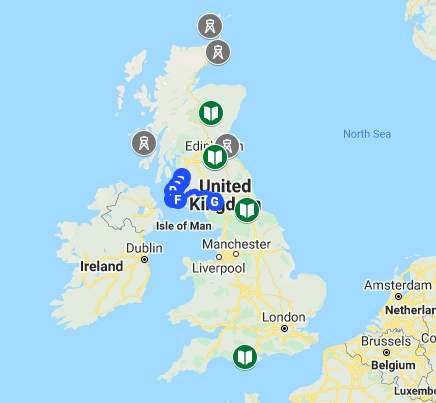
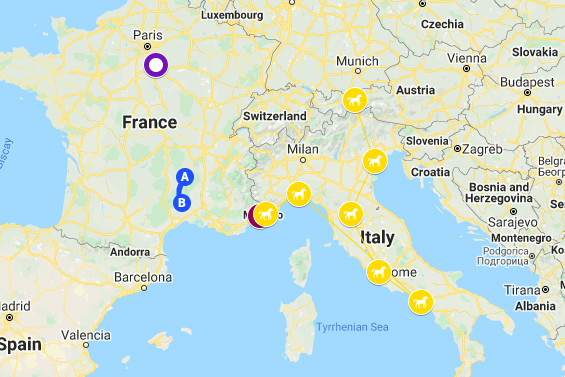
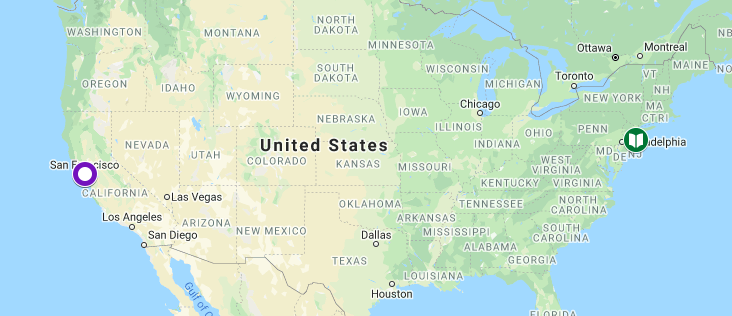
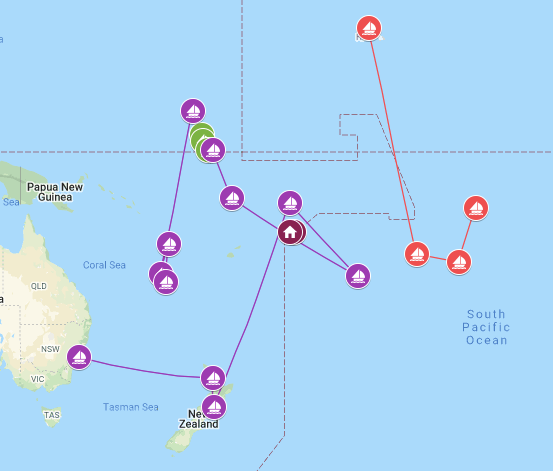
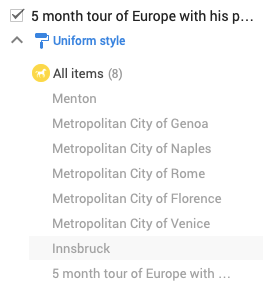
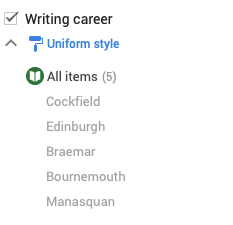
The author is very well travelled. As the map shows us, he has visited pretty much all of Europe as well as the United States and many islands on the Pacific Ocean.
The author was always on the move. As the map shows us, he never settled in a specific place. Moving from Edinburgh, to the United States, to France… and finally spending his final days in the Samoa Islands where he was buried.
The author’s travels led him to meet a lot of influential people who helped him in his writing career. For instance, he met Sidney Colvin in England who eventually became his literary adviser and was the first editor of his letters after his death. Colvin also placed Stevenson’s first paid contribution in The Portfolio, an essay entitled Roads. Another person he met along his travels was Will Lowe in Manasquan, New Jersey who later translated Treasure Island into the official French version in 1890.
One of the author’s trips led him to find his big love. The canoe voyage Robert Louis Stevenson conducted with Simpson in 1876 brought him to Grez in September 1876 where he met Fanny Osbourne who he later married in 1880 and spent the rest of his life by her side.
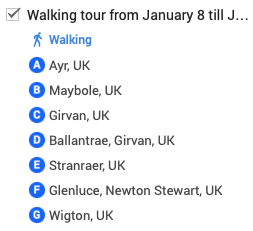
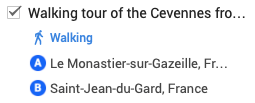
Being the adventurous writer that he is, we found out that his exploring tours inspired his writings a lot. Stevenson often played a primary role in his tales of travel, and he was very willing to poke fun at his own discomfort and awkwardness in strange situations. A classic example was the book he wrote after his walking tour of the Cevennes in 1878. Travels with a Donkey in the Cevennes colourfully recounts the author’s inability to get his donkey, Modestine, to move.
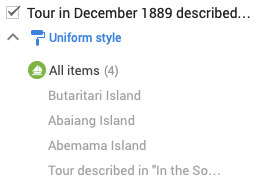
The places he visited and the people he met inspired the settings and the characters of his novels. It was during his time in Bournemouth that he wrote his famous story The Strange Case of Dr. Jekyll and Mr. Hyde, naming the character Mr. Poole after the town of Poole which is situated next to Bournemouth. In Westbourne, he named his house Skerryvore after the tallest lighthouse in Scotland, which his uncle Alan had built. On the other hand, he took part in a cruise visiting the South Pacific Ocean islands in 1889 which he described in In the South Seas.
The author chose Samoa to spend his last days in. Samoa was his go-to place because Stevenson liked the people, it was not too “civilized” and had a regular mail service which was essential for his connections with agents, editors and publishers. He died there of a cerebral hemorrhage and was buried on the summit of Mount Vaea on Upolu. The Samoans cleared a path to the top of the mountain overnight in order to be able to bury him there.
Contrast between close reading The Strange Case of Dr. Jekyll and Mr. Hyde and mapping the locations of the story
Having read The Strange Case of Dr. Jekyll and Mr. Hyde, the story grabbed our attention since it was very intriguing and mysterious. Every major event occurring kept us on the edge of our seat; but we didn’t pay much attention to the timing and location of the events as much as we did to the events themselves.
Now, having mapped the novel on Google My Maps, we can clearly see how Robert Louis Stevenson calculated the timings and locations of major events occurring in his book. The story made much more sense, and as readers, we could feel that it was more interesting knowing and to visualize where did these things happen exactly, whether it be for the character swap between Dr. Jekyll and Mr. Hyde’s split personality, or having an insight on where brutal killings took place.
The Strange Case of Dr. Jekyll and Mr. Hyde
The Strange Case of Dr. Jekyll and Mr. Hyde mapThe Strange Case of Dr. Jekyll and Mr. Hyde legend
Servants, discrepancy between rich and poor, the repression? That’s all 100% Victorian England. This setting allows Dr. Jekyll to become a more sympathetic character. It also explains why he needed to unleash his inner Hyde. In fact, you could go so far as to say that this book, because of its setting, provides social commentary on the place and time.
The Victorian London setting is important because it is what pushes Jekyll into making Hyde. Stevenson had apparently considered setting his tale in Edinburgh, with its poverty-stricken old town and illustrious new town making clear allusions to Jekyll and Hyde’s personalities again. However, in high London society, a man’s reputation was everything, he couldn’t do whatever or whenever he pleases. Jekyll is repressed by his lifestyle as a rich doctor, it is only as Hyde that he can do what he actually wants and so he creates Hyde. The setting is important here because it is what forces Jekyll’s hand into making an alternative person for himself.
Moreover, we realized that Jekyll’s house is really close to Hyde’s place which could be understandable since they are the same person. Hyde terrorises the occupants of London as he will trample and destroy anyone who gets in his way – the little girl and Sir Carew (as they are plugged in the map). London’s twisting medieval streets and fogged new streets become the maze in which the minotaur was kept. You never know when the minotaur or Hyde might appear to hurt you. Setting then becomes a metaphor for evil.
Kidnapped
Kidnapped map
Kidnapped legend
Kidnapped takes place in 1751 in Scotland, which is Robert Louis Stevenson’s home country. After researching Scotland’s history at the time, we found out that it was subdued by the English military. To clamp down on clans wanting independence, the English have started imposing laws on Scottish people to prevent them from carrying or owning weapons and wearing traditional Highland dress since their clothes can be related to an affiliation to a clan.
Davie, the protagonist, is a Lowlander and loyal to the English throne. So while there’s a fair amount of admiration for the Highland rebels, ultimately, Davie does return to the Lowlands with Alan in tow. Davie is a stranger to the Highlands, and his introduction to this unfamiliar country is as intriguing to him as it is to the reader.
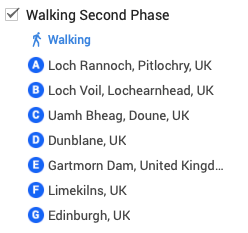
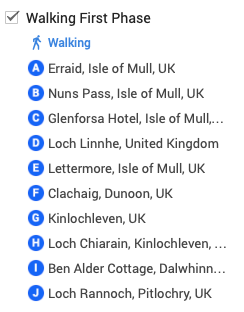
We advise readers of this novel to keep a map of Scotland around them while reading, or in our case, to constantly check the locations and its corresponding legend that we mapped on Google My Maps since this will make the story a lot more interesting and easier to follow. Stevenson is very committed to get both his geographical and historical facts straight, so it’s possible to trace the route that Davie and Alan are supposed to have traveled around the northwest of Scotland, shown by the different blue points on the map. By including so much detail in a fictional adventure story, Stevenson increases the plausibility of what might otherwise seem like a pretty far-fetched story of shipwreck, conspiracy, and murder.
Problems we encountered while mapping
We can definitely say that mapping Stevenson’s life achievements and literary works helped us with our analysis in order to understand more the duality of evil and good, especially in The Strange Case of Dr Jekyll and Mr Hyde. Let us not forget how much the colored icons and lines in the maps are aesthetically pleasing to the eye.
However, while working on Google My Maps, we encountered some issues. At first, it was a bit of a challenge not knowing how to get all locations of Stevenson’s books since we were not that familiar with Topotext. Later on, while mapping the author’s life we faced numerous problems. On one hand, there were some unfound locations, probably due to the present absence of some monuments or the change in their names. On the other hand, the limited number of layers was also an issue for us since Robert Louis Stevenson visited a lot of countries for different reasons. So, we were limited to 10 layers which made us filter and include only the important parts of Stevenson’s life.
But regardless of these issues, mapping Stevenson’s literary works and his life achievements was a great experience!
We’re all used to carefully reading novels and poems and reflecting on them ever since we started analyzing literature. However, we recently learned a new method of analyzing texts called Distant Reading. Distant Reading refers to a professional reading method that relies heavily on computer programs. It was created by Franco Moretti who wanted to analyze thousands of pieces of literature by simply feeding them into a computer. We got familiarized with two text analysis tools called CliC and Voyant-Tools and chose three novels written by Robert Louis Stevenson in order to discover how these tools work and dig more into Distant Reading.
Reading ‘more’ is always a good thing, but not the solution
Franco Moretti
There’s something satisfying about murder mystery books. The crime of murder is inherently terrifying, which makes these stories part horror fiction and part puzzle. You can feel the danger of murder looming in the background while also having the satisfaction of solving the crime in the foreground of the story. Having read “The Strange Case of Dr Jekyll and Mr Hyde” by Robert Louis Stevenson, we, as a team, decided to focus also on two of his other adventurous novels written during the same era: Kidnapped and Treasure Island. All three texts that we chose were available on CliC. However, we had to use The Gutenberg Project, a database of over 60,000 free eBooks, as a resource for building our corpus in order to analyze it using Voyant Tools.
The Strange Case of Dr Jekyll and Mr Hyde (1886)
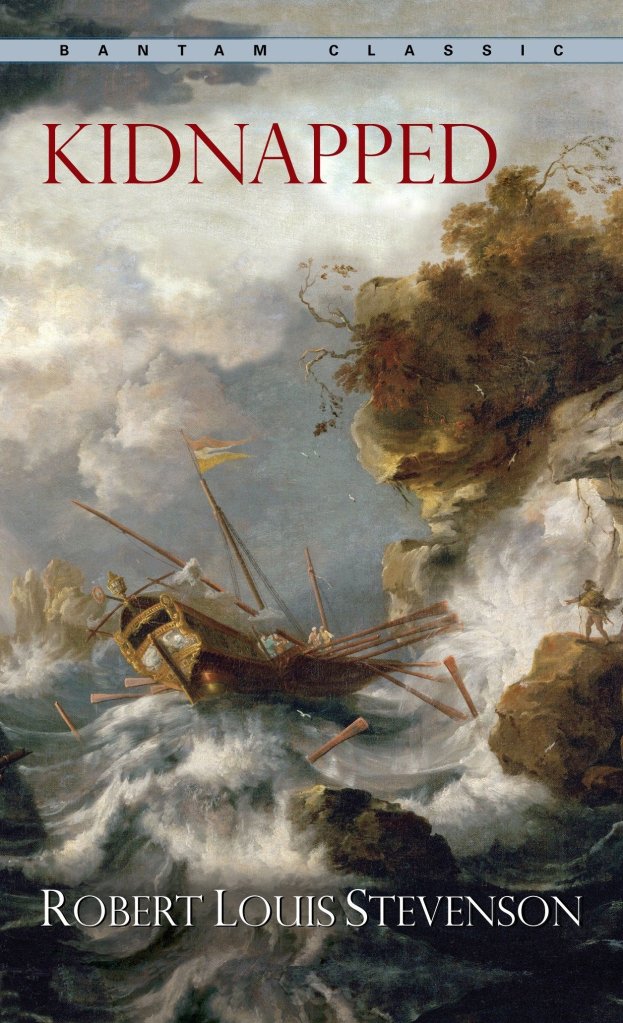
Kidnapped (1886)
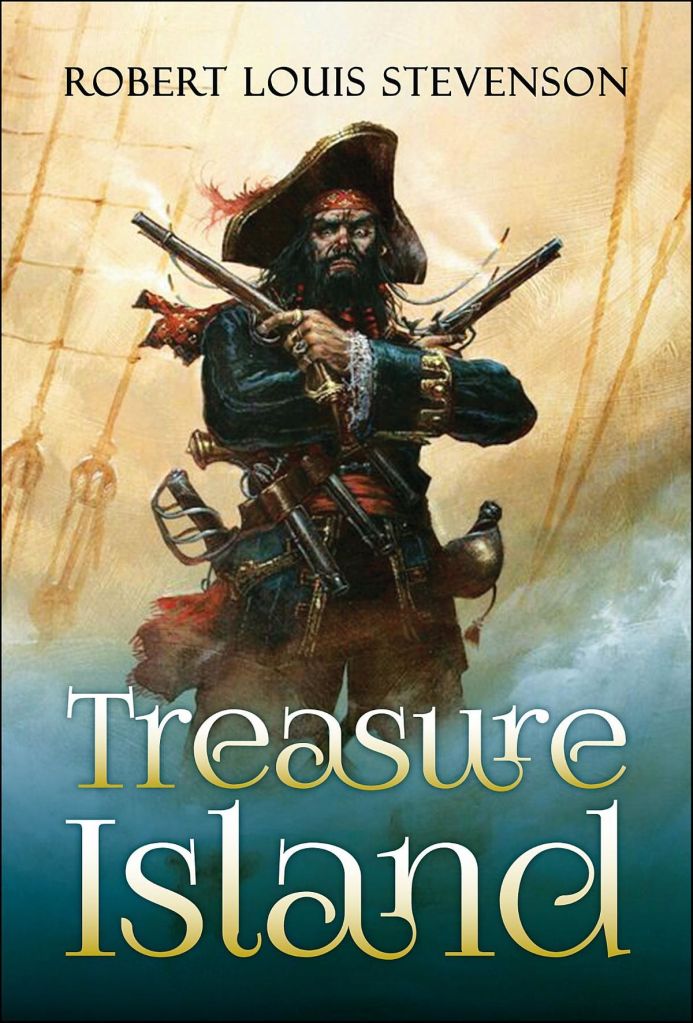
Treasure Island (1881)
Our Corpus
Many questions arose during our corpus analysis as a group, but we managed to narrow them to two main topics:
Throughout the novels, there is a notable lack of female characters compared to male presence. When they do appear in the story, they are victims or servants rather than more prominent roles. How is this a reflection of life in Victorian England?
It is known that during the Victorian era, when Stevenson released his books, women were considered as belonging to the domestic sphere. This stereotype required them to only provide their husbands with a clean home, to put food on the table and to raise their children. Even though symbolized by the reign of British monarch Queen Victoria, women did not have the right to vote, sue, or own property. Having previously read Stevenson’s work (Close Reading), we noted critical moments of feminine quality in these male-centered stories that are identified through the roles that female charactres play as (1) humble counterpart to males in socio-cultural context and (2) feminine energy in sex and sexuality in the gender context.
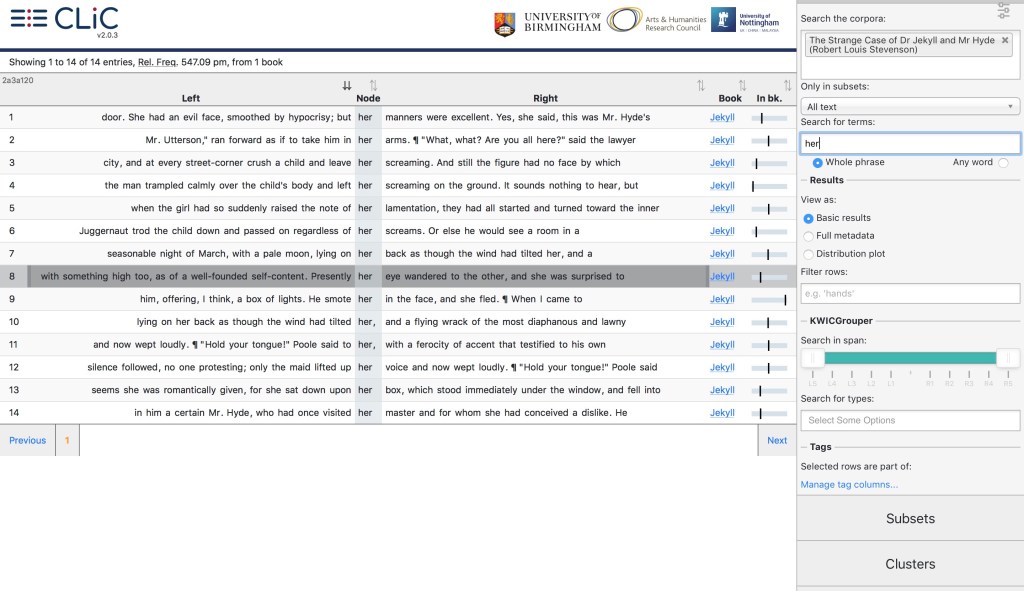
Based on this idea, we wanted to see if Distant Reading tools would provide us with the same results. We first started analyzing “The Strange Case of Dr Jekyll and Mr Hyde” on CliC, we went to “Concordance” and searched for the term “her” and realized that it was associated with the words “scream”, “lamentation” and “master” which emphasizes the female role as victims and servants.
Snapshot of Concordance tool in CliC
Digging deeper into our analysis, we also tried searching in the “Concordance” feature for the word “woman” and found the sentence highlighted in yellow expressing the author’s point of view towards females through one of the characters. Stevenson used the term “woman” as a way to describe weakness by comparing it to a “lost soul” and associating it with the demeaning word “weeping”. Searching for the exact definition of the word “weeping”, an example related to the Victorian times was given: “a Victorian tombstone that depicted a weeping woman”, which is a reflection of life in Victorian England.
Snapshot of “Concordance” tool in CliC
Snapshot of the definition of the word “weeping”
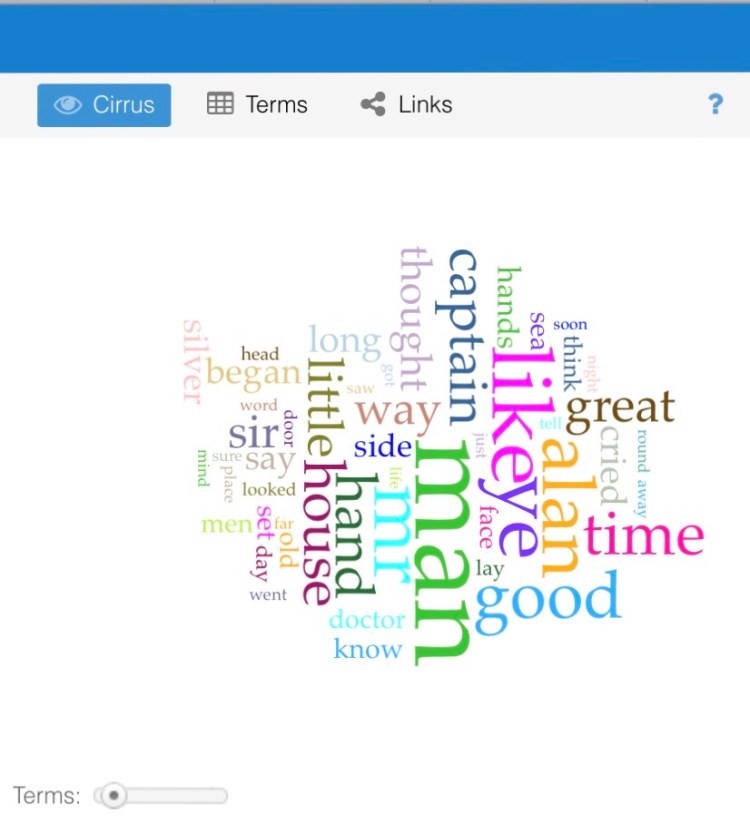
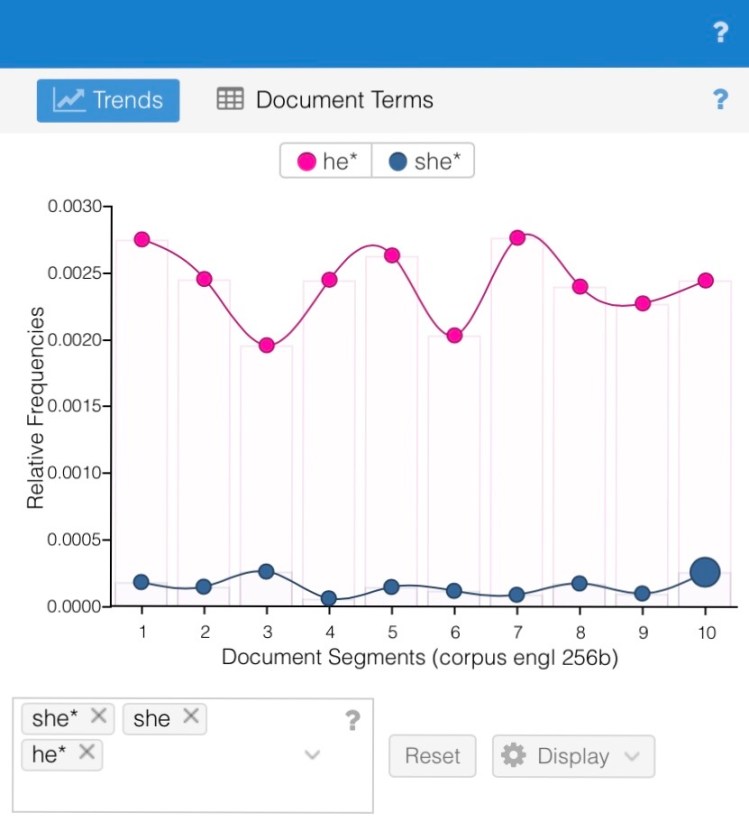
Switching tools, we uploaded our Stevenson corpus and started with “Cirrus”, which shows the most frequently used words displayed in a colorful manner, very pleasing to the eye. After modifying the stoplist by excluding common words such as “like”, “come”, “said”, we realized that “man” is the most frequent term. Additionally, the “Trends” tool helped us visualize the dominant frequency of the term “he” compared to “she”.
Snapshot of Cirrus and Trends in Voyant tools
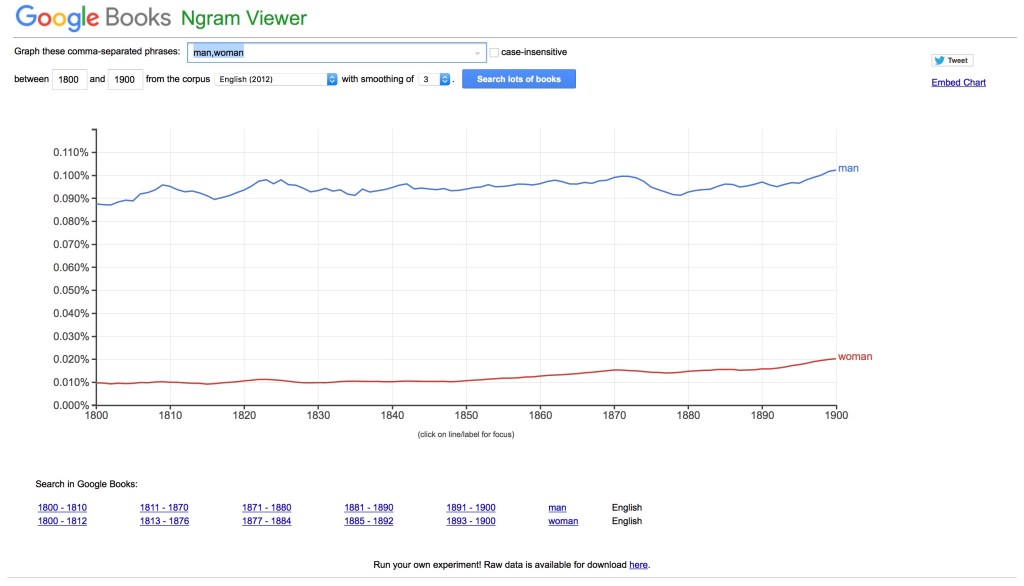
This information triggered our curiosity, and we learnt that in the 19th Century “man” was used almost 80% more than “woman” in books with the help of Google Ngram Viewer, which could refer to a gender bias era. Moreover, we found out that women during the Victorian era were considered as belonging to the domestic sphere, this stereotype required them to only provide their husbands with a clean home, to put food on the table and to raise their children.
Snapshot of Google Ngram Viewer
Good and evil are so close as to be chained together in the soul
Robert Louis Stevenson
The novels revolve around the contest between good and evil. Who wins in the end?
Stevenson always believed that humans have a good and an evil side. According to him, both versions live inside of us, only that the evil one is always repressed by society. These thoughts led him to write the famous book Strange Case of Dr. Jekyll and Mr. Hyde, a story about a character with a complex personality disorder.
Stevenson uses Dr. Jekyll, and Mr. Hyde as metaphors representing good and evil. Throughout the story, the duality and contrast is present and taking centre stage. He also wanted to point out how evil can express itself in anyone, no matter how rich, or how much we think we know someone. Even Jekyll had a bad side to him which caused him to create Mr. Hyde, who does a lot of horrible acts that are unforgivable. On one hand, Mr. Hyde was compared to Satan in the book, which emphasizes on how evil Mr. Hyde is.
Snapshot of the text “the Strange Case of Dr Jekyll and Mr Hyde” where Mr Hyde is compared to “Satan”
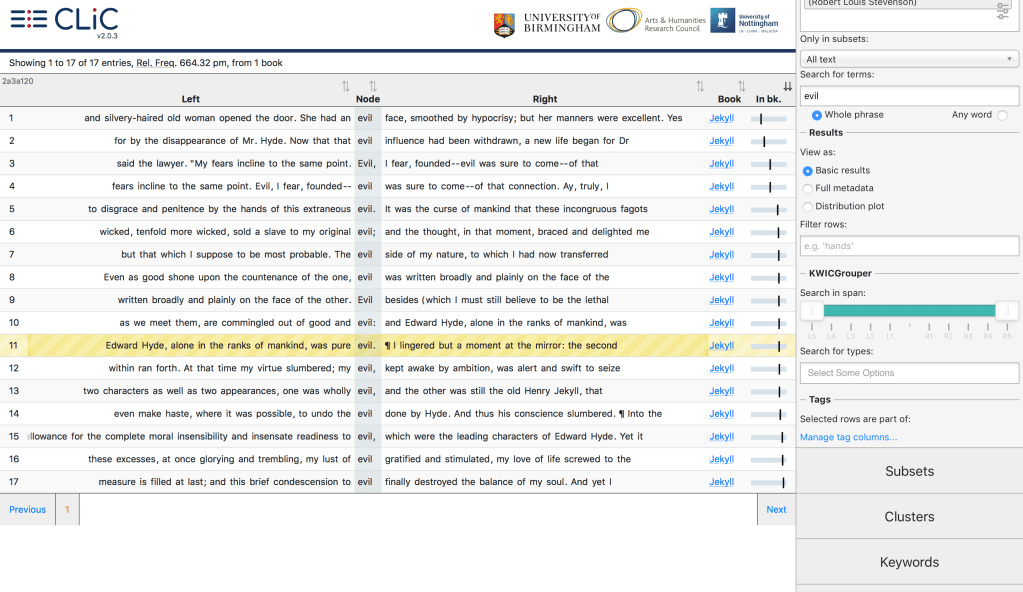
We searched for the term “evil” in “Concordance” tool and found an eye-catching sentence saying that Edward Hyde was pure evil.
Snapshot of “Concordance” tool in CliC
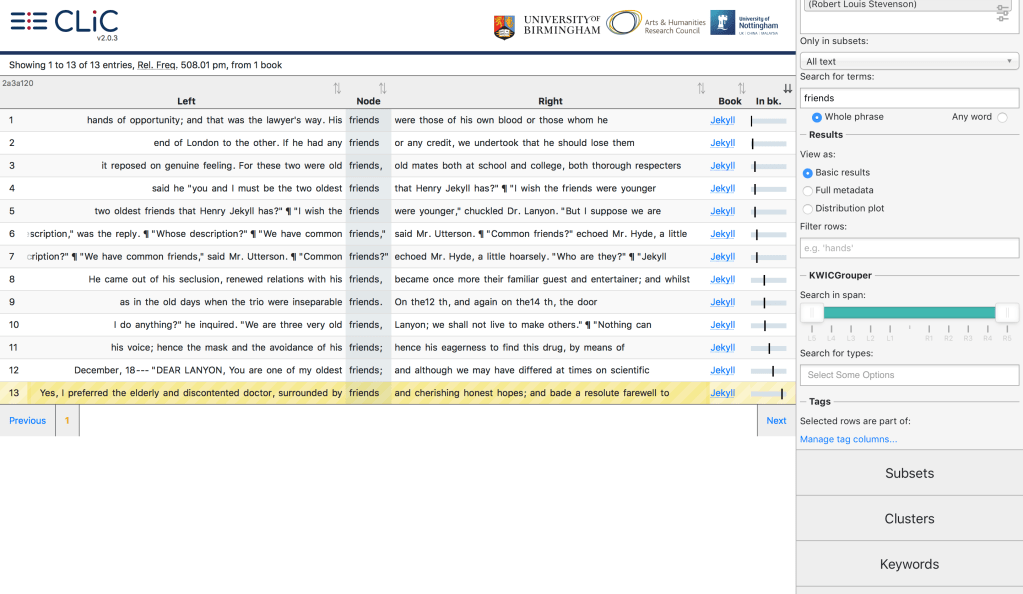
On the other hand, Jekyll represented the complete opposite of Hyde. He was well liked by the people around him and was a respected figure which was shown in the yellow highlighted sentence below after searching for the word “friends” in the “Concordance” feature on CliC.
Snapshot of “Concordance” tool in CliC
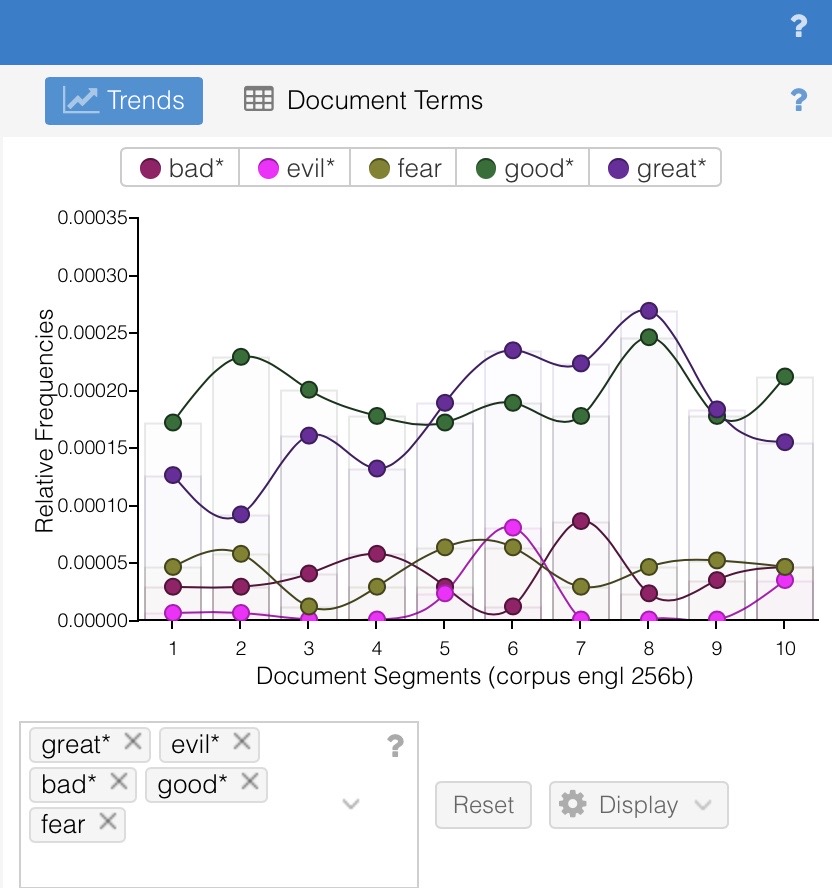
The most surprising thing we found from our analysis was that the words we thought would be associated with the stories such as “evil”, “fear”, and “bad” are extremely small compared to “good” and “great”. This is illustrated in a graph by “Trends” tool on Voyant.
Snapshot of Trends in Voyant tool
As distant readers, we would think that “good” would always win in the end of each story. For example, in “Kidnapped”, Stevenson focuses on the fact that there will always be some bad apples, but instead of getting away with it like Long John Silver did in “Treasure Island”, he adds to it that extra amount of effort, the good will always emerge victorious. However, switching to Close Reading for “The Strange Case of Dr. Jekyll and Mr. Hyde”, the final statement of Henry Jekyll (explaining everything before his death/suicide) shows that Mr Hyde took over Dr Jekyll’s thoughts which led the doctor to end his life. This is a representation of a case where evil conquered good. Multiple sentences in Jekyll’s final statement proves this point:
“The powers of Hyde seemed to have grown with the sickliness of Jekyll.”
“The hatred of Hyde for Jekyll, was of a different order.”
“Here then, as I lay down the pen and proceed to seal up my confession, I bring the life of that unhappy Henry Jekyll to an end.”
We can finally say that in spite of our great results with distant reading tools, a better analysis can be done with close reading.
Whereas most text analysis tools are not designed for beginners in the digital humanities field like us, we found that Voyant-Tools and CliC were very clear and that their websites provided straight-forward explanations about their different features containing texts, screenshots, and screencast tutorials in the case of Voyant-Tools. Their best feature is their user- friendliness, evidenced through their extensive documentation, simple user interface, and an ability to export data. The most attractive is the simple. This quality is exhibited in the single data-entry field on the homepage as well as the panels on the data analysis dashboard. Each panel contains a different tool useful for text analysis, like Cirrus a word cloud generator on the Voyant-Tools website.
However, the only limitations of Voyant Tools were the occasional prolonged text-loading time and the challenge of gathering information using some visualization tools configured in the Voyant Skin Builder. As for CliC, you may not find a specific text or corpus you would like to analyze sometimes because of its limited text availability.
To sum up, an obvious difference between Distant and Close Reading is that a computer can analyze thousands of books by a click of a button whereas it would take years for us humans to go through the same number of books. In addition, another problem of Close Reading is the subjectivity. Every person analyzes a book with an opinion. A computer’s work is more objective and analyzes the texts as they are. There are no emotions involved. And a computer can find hidden aspects in plots by transforming them into networks. However, when using Distant Reading, readers don’t get the full experience of reading a book and can’t fully understand the messages that the authors are trying to deliver to the readers.
Hope you enjoyed our blog about new distant reading tools!

















 Anna's Blog